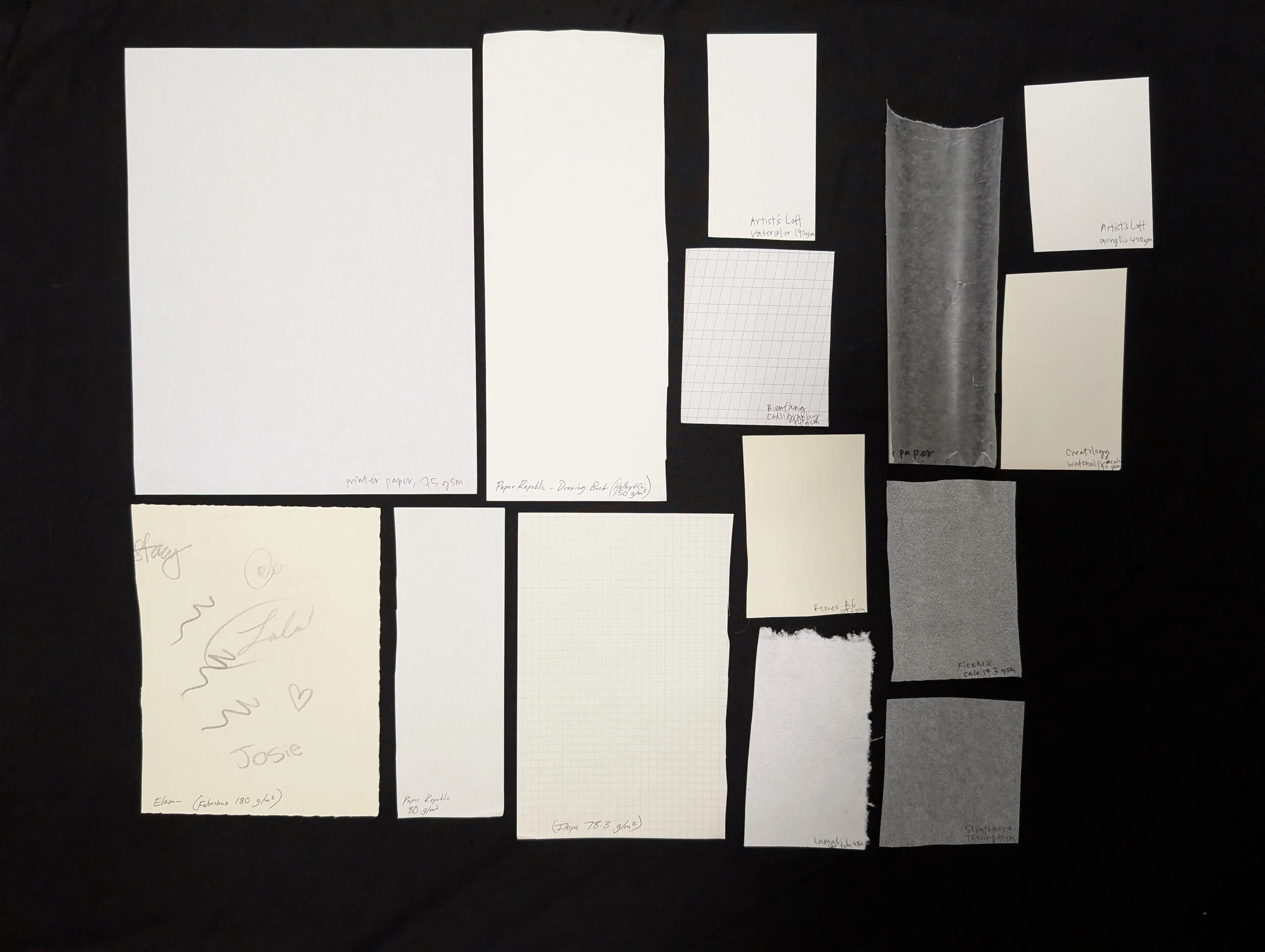
Putting Pen to Paper: A Study of Fountain Pen Ink/Paper Interactions
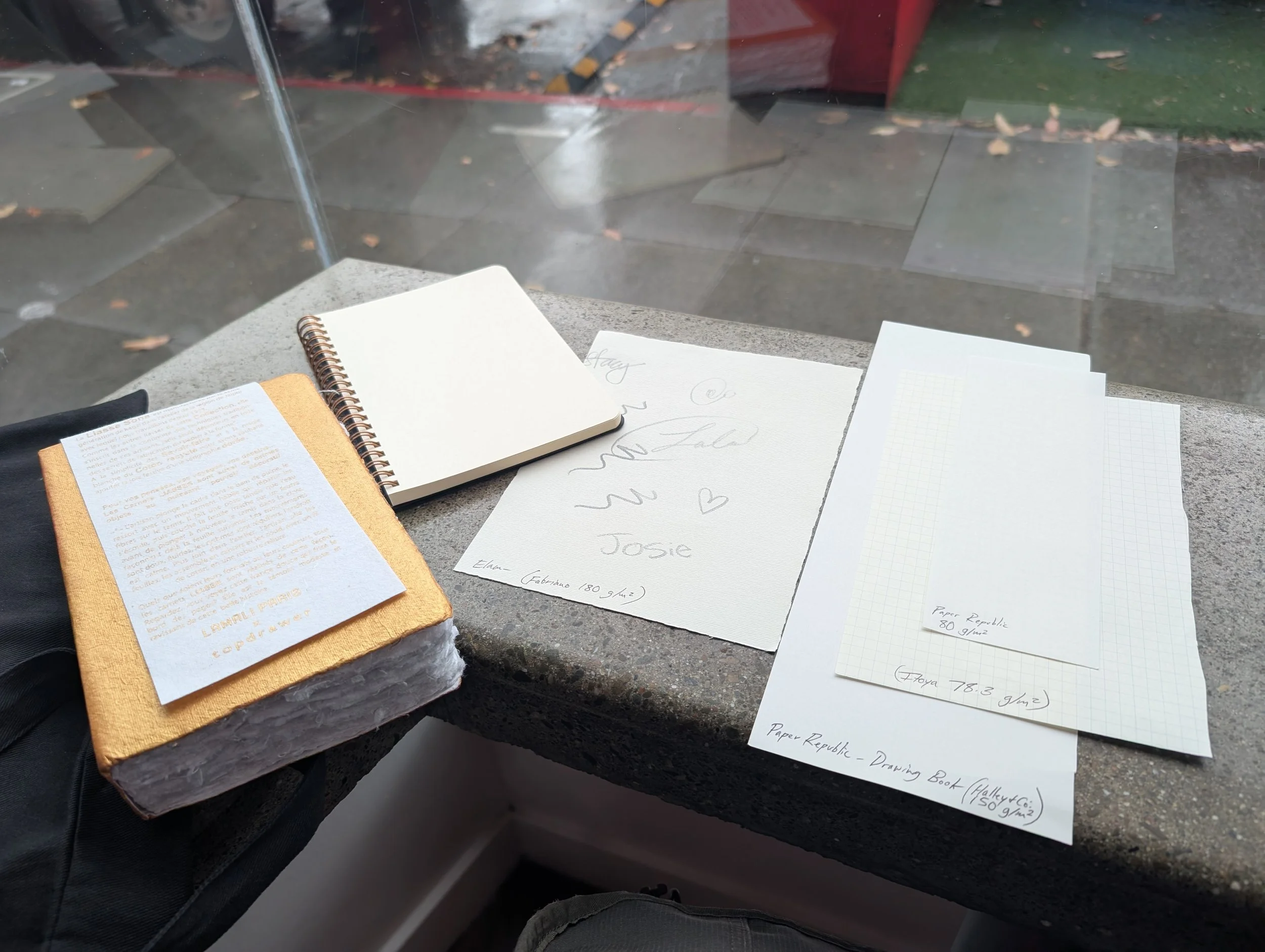
In early April 2026, I visited a stationery store in San Francisco on a whim. Originally, I was looking around for a new pen for my spouse, but became very interested in the wide array of papers they sold. The store manager was super friendly and chatted with me for an hour or so about paper, and how its weight, texture, and composition could drastically affect the way inks and paints behave on the page. I left with a handful of paper samples and excitement to see it in action. Within a few days, I’d made a set of figures showing how the same ink and fountain pen could look on a variety of papers. I also made a video, shared to an old YouTube channel, highlighting some of the basic concepts/phenomena related to ink uptake in paper.
Over the next several months, I eagerly investigated the relationship between paper and ink properties using optical microscopy, scanning electron microscopy (SEM), and paper chromatography. And I’m so very intrigued by how modifications to cellulose fiber structure (e.g. size, organization, and inter-fiber spacings), paper coatings, and ink composition can impact the behavior and appearance of ink on paper.
I’ve yet to compile my findings into a larger cohesive work (because the nature of curiosity-based independent science means the work is less inclined to have a neat ending), but I’ve written up and shared some theories around the impact of paper composition and structure on ink behavior on Reddit (u/Odd-Marionberry-3389), as the fountain pen subreddit and related spaces offer the perfect place for me to share my findings and solicit feedback from knowledgeable and invested community members. Here are some of my recent in-depth analyses:
And here are some interesting observations I’ve also written up as reddit posts:
Tombow Fudenosuke soft tip marker (stereo/compound) microscopy-based analysis
Inks on various substrates under the microscope [figures of dried ink, video of drying inks]
Kiwi Inks’ Treasures of Atlantis drying timelapse under the compound microscope
Wet Herbin Emerald de Chivor ink under the compound microscope (reflected/transmitted lighting)
Various dried fountain pen inks on glass, acrylic substrates under the compound microscope
Pilot Iroshizuku Kon-Peki Ink undergoing Marangoni effect under the stereo microscope
Dried Herbin Emerald de Chivor ink under the compound microscope (transmitted lighting)
I’ve also presented on my work at the Ronin Institute for Independent Scholarship 2.0 (RIIS 2.0) August 2026 Lightning Talk series; you can find a recording here on my YouTube channel.
My ink and paper research is ongoing, and these days I’m interested in:
Following up on reported “interesting” observed phenomena by fountain pen subreddit/discord users
Continuing to characterize different varieties of papers - especially ones suggested by inkmakers and super-fans (people in the fountain pen community who are very knowledgeable about paper properties, manufacturers, and issues) - via optical microscopy, SEM, and other methods.
Conducting a failure analysis on the infamous 2024-2025 era Tomoe River 52 gsm quality excursion [1, 2], where fountain pen aficionados lamented a noticeable decrease in the paper’s performance, with reported feathering and bleed. I’m currently soliciting donations of Tomoe River 52 gsm from three distinct periods, for optical microscopy, SEM, and (possibly) FT-IR studies:
Pre-excursion baseline
Mid-excursion
Post-excursion new baseline
Developing materials science/chemistry-based theories to explain “sheening,” “shimmer” particle behavior, and “chromashading” behavior of inks when applied to different papers, through microscopy-based studies